Written by eightmedia_rhea
on 4 September 2026
Local Government Reorganisation (LGR) is set to be one of the most significant local government reform programmes to reshape England’s public sector landscape in decades. While much of the discussion has focused on council mergers and governance structures, the reality is that LGR represents a much broader transformation programme, one that will affect people, processes, systems, data, and decision-making across local government.
For councils navigating this change, understanding the implications of LGR and preparing early will be critical to ensuring a smooth transition and realising the benefits that reform is intended to deliver.
What is Local Government Reorganisation?
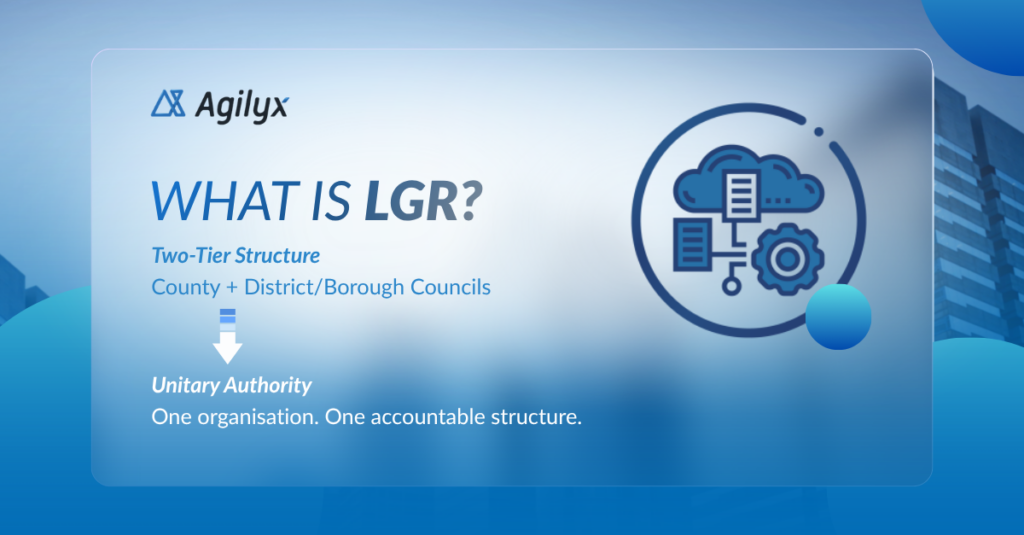
Local Government Reorganisation is the Government’s initiative to simplify local government structures by replacing remaining two-tier arrangements with larger unitary authorities.
In a two-tier system, responsibilities are shared between county councils and district or borough councils. County councils typically oversee services such as education, social care, highways, and children’s services, while district and borough councils are responsible for areas such as housing, planning, environmental services, and waste collection.
Under LGR, these responsibilities are brought together under a single unitary authority, creating one organisation accountable for delivering all local government services within a defined area.
The goal is straightforward: simplify governance, reduce duplication, improve accountability, and create more efficient public services.
However, while the structural concept may be simple, the practical delivery is far more complex.
Why is LGR Happening?
The pressures facing local government have never been greater.
Councils across the country are managing increasing demand for services while operating within challenging financial environments. Areas such as adult social care, children’s services, housing support, and special educational needs continue to place significant pressure on resources.
At the same time, many authorities are being asked to deliver higher levels of efficiency, improve service outcomes, and demonstrate clear accountability for public spending.
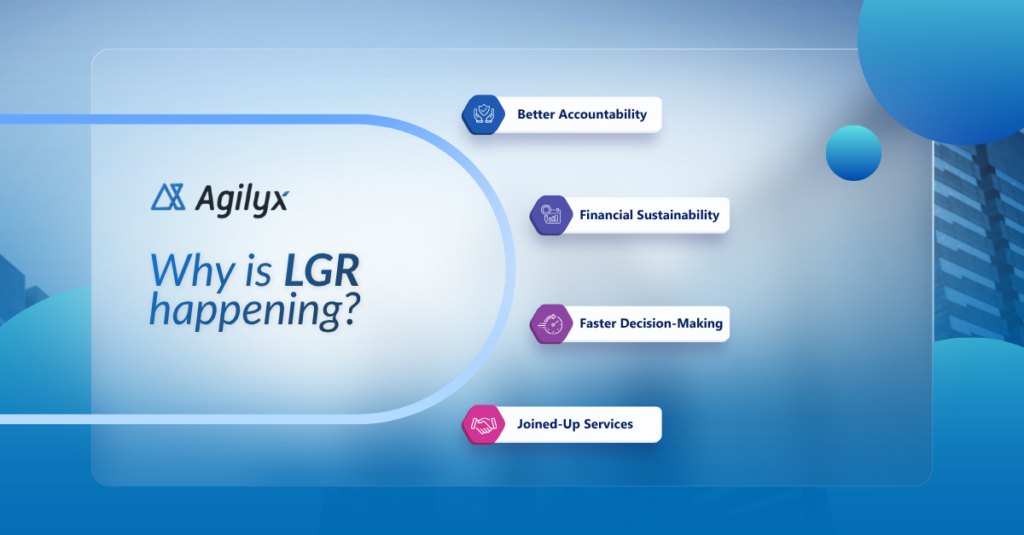
The Government believes that larger unitary authorities can help address these challenges by:
Reducing Duplication
Where multiple councils currently operate separate functions, systems, and administrative structures, a single authority can reduce overlap and create efficiencies.
Improving Accountability
Residents often find local government structures difficult to navigate. Unitary authorities provide a clearer model, with one organisation responsible for delivering local services.
Supporting Faster Decision-Making
Fewer layers of governance can enable councils to make decisions more quickly and respond more effectively to local priorities.
Creating More Joined-Up Services
By bringing services together within a single organisation, authorities can improve collaboration and deliver more integrated outcomes for communities.
While these ambitions are compelling, achieving them depends on more than organisational restructuring alone.
The Hidden Challenge Behind LGR
When people think about council reorganisation, they often picture organisational charts, governance arrangements, and new leadership structures.
In reality, one of the biggest challenges lies beneath the surface.
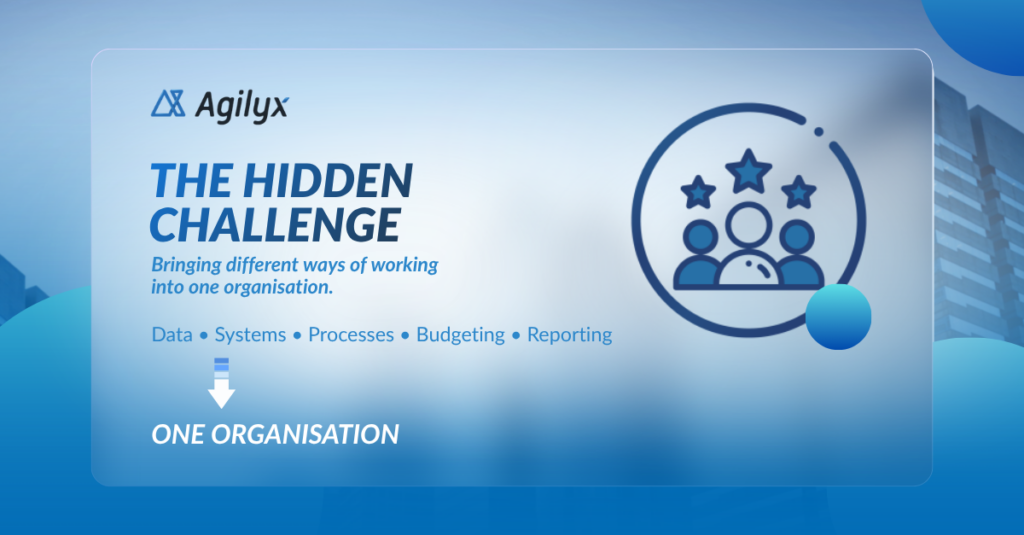
Every council has developed its own ways of working over many years. Different authorities often use different systems, reporting structures, budgeting processes, planning methodologies, and data standards.
When organisations merge, these differences don’t disappear overnight.
A newly formed authority may inherit:
- Multiple financial systems
- Different reporting frameworks
- Inconsistent planning processes
- Separate datasets
- Varying governance approaches
- Spreadsheet-dependent workflows
Bringing these together into a cohesive operating model takes careful planning and strong leadership.
Put simply, creating a new organisational structure is only the beginning. Creating a single organisation capable of making confident, informed decisions is the real challenge.
Why Data and Visibility Matter
Successful reorganisation depends on the ability to understand what’s happening across the organisation, both during the transition and beyond.
Leaders need confidence in their information.
They need to understand financial performance, workforce requirements, service demand, budget pressures, and operational risks across the entire authority.
Without trusted data and consistent reporting, decision-making becomes slower, more difficult, and increasingly reliant on manual processes.
This is particularly important during periods of change, when leaders are often required to evaluate multiple scenarios, respond to evolving priorities, and make decisions with significant long-term implications.
The councils that gain the greatest value from LGR are likely to be those that establish strong foundations for planning, reporting, and collaboration from the outset.
How Councils Can Get Ahead of the Curve
Although every authority will face its own unique circumstances, there are several steps organisations can take now to prepare for the changes ahead.
1. Understand Your Data Landscape
Identify where critical data resides, how it is managed, and where inconsistencies may exist.
2. Align Planning Processes
Review budgeting, forecasting, and reporting processes to identify opportunities for standardisation.
3. Create a Single Source of Truth
Ensure decision-makers have access to trusted, consistent information across the organisation.
4. Strengthen Scenario Planning
Reorganisation programmes rarely follow a perfectly linear path. Building robust planning capabilities allows councils to model different outcomes and prepare accordingly.
5. Focus on Long-Term Transformation
LGR should not be viewed as a short-term compliance exercise. It presents an opportunity for long-term local government transformation, modernising processes, improving collaboration, and building a more resilient organisation for the future.
How Agilyx Supports Public Sector Transformation
At Agilyx, we work with public sector organisations to improve planning, forecasting, reporting, and decision-making during periods of transformation.
Whether councils are preparing for Local Government Reorganisation, modernising finance processes, or seeking greater visibility across services, the ability to access trusted data and align planning across the organisation is becoming increasingly important.
Successful transformation is rarely achieved through structural change alone. It requires the right processes, the right information, and the confidence to make informed decisions.
Looking Ahead
Local Government Reorganisation represents far more than a governance reform programme.
It is a once-in-a-generation opportunity for councils to rethink how they operate, collaborate, and deliver services to their communities.
While organisational structures may change, the authorities that achieve the greatest success will be those that use this moment to strengthen their foundations, connect their data, improve visibility, and create a more agile approach to decision-making.
The question is no longer whether change is coming.
It’s whether organisations are ready to make the most of it.
Ready to Prepare for Local Government Reorganisation?
Local Government Reorganisation is about more than restructuring. It’s an opportunity to strengthen planning, improve visibility, and build a more resilient organisation.
If you’d like to explore how councils can prepare for organisational change, connect data across services, and create a single source of truth for decision-making, we’re here to help.
Get in touch with the Agilyx team to start the conversation.
Nicole Tarling
Business Development Representative | Agilyx Group
Nicole.Tarling@agilyxgroup.com
07761 515996